BlogAugust 10, 2026

The Bill Arrives Later: The Human Cost of Internet Shutdowns in Iran

A shutdown does not end when the signal returns. Its economic, educational, medical, and psychological costs continue afterwards.
SeyedAli Emami
The Bill Arrives Later: The Human Cost of Internet Shutdowns in Iran
The easiest way to misunderstand an internet shutdown is to count only the hours when a website is unreachable. The real bill arrives later. It appears as a missed customer, an unpaid invoice, a delayed shipment, a cancelled class, an interrupted medical record, or a small business that cannot tell whether its audience has disappeared or simply cannot reach it. Iran’s online economy was built under difficult conditions: sanctions, inflation, filtering, expensive workarounds, and unstable access. Many people learned to keep a business alive with a phone, a messaging channel, a social page, and a payment link. That system is already fragile. A nationwide shutdown removes several supports at once.
A home-based online business paused by a disconnected network
For a small seller, a post is not just marketing. It can be the shop window, the customer-service desk, the catalogue, and the proof that the business is still active. When the network is cut, customers cannot ask questions. Sellers cannot confirm stock, send a tracking number, receive a payment notification, or explain a delay. A buyer may move to another seller—not because the product is worse, but because no one can reply. Trust is lost through silence. The damage is especially heavy for home businesses and freelancers. They often do not have a physical storefront or a large cash reserve. A few weeks of lost orders can erase months of progress. A designer, translator, developer, teacher, or online retailer may still be ready to work, but readiness is not enough when the customer, platform, file, and payment system are all outside the reachable network. Reporting by The Associated Press during the long 2026 shutdown described businesses across fashion, fitness, advertising, and retail losing their main route to customers. The story is not only about lost revenue. It is about people who had already adapted to restrictions and were then asked to absorb another systemic interruption. When people talk about education during an outage, they often imagine a class meeting that cannot start. The deeper problem is the missing ecosystem around the meeting. A student may lose access to a research paper, a university portal, a cloud folder, an update from a professor, or a scholarship form. A teacher may be unable to share an assignment or confirm a deadline. A group project can break because the shared document is unreachable. Even after access returns, the missed time is not always recoverable: an exam window closes, a visa deadline passes, or a student loses contact with a supervisor in another country. The burden is not evenly distributed. Students with private tutors, international accounts, or reliable alternate connections can compensate. Others are forced back to paper, memory, and informal networks. Offline materials can help, but they do not replace an accessible and dependable educational system.
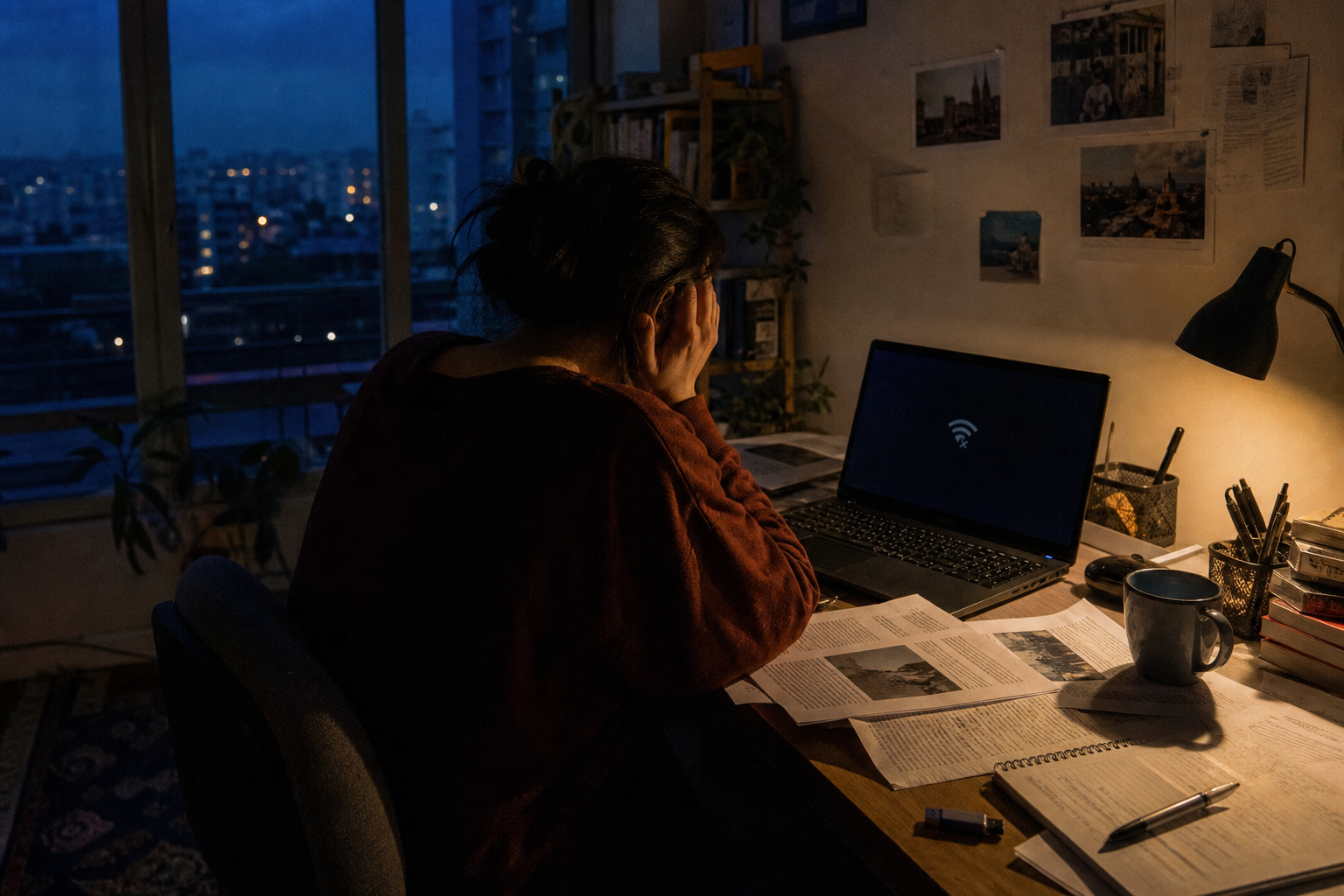
A student studying from printed pages while a laptop remains offline
Healthcare depends on communication even when the patient never opens a browser. Pharmacies check stock. Clinics coordinate appointments. Doctors share records and receive test results. Families search for medication availability and ask whether a prescription can be filled elsewhere. When those systems are unavailable, workers create paper workarounds. That can be necessary and sometimes effective, but it adds the risk of duplicate records, missed updates, transcription mistakes, and longer queues. A patient who needs a specific medicine may spend more time calling, travelling, or asking several people for information. The problem is not that every clinic becomes unsafe; it is that the margin for error becomes smaller while the pressure becomes greater. The same applies to public health communication. During a crisis, people need clear guidance that they can verify. If the network is unreliable, official messages may not reach everyone, while rumors continue to move through informal channels. The information gap becomes a health risk of its own.
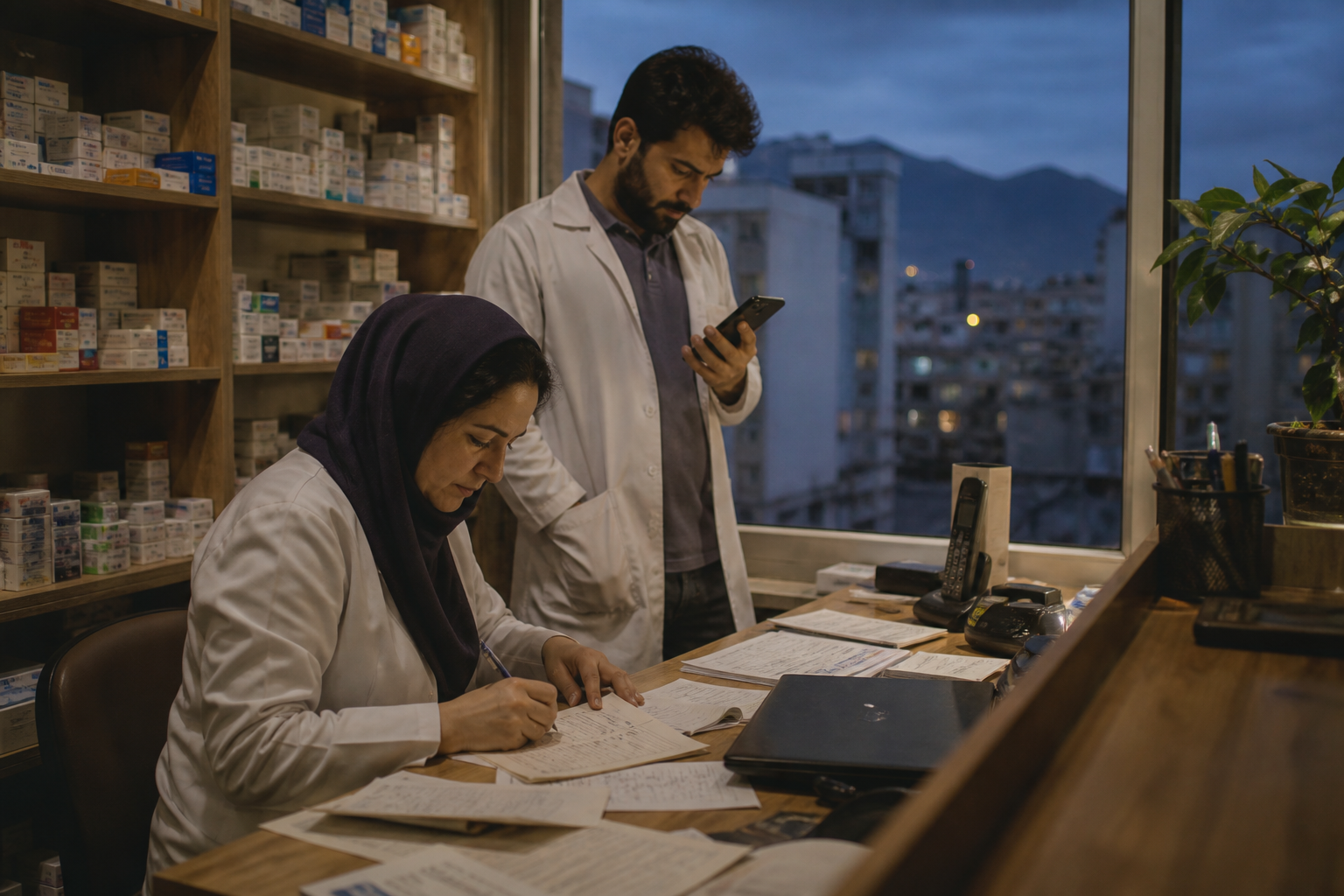
A pharmacy team using paper records while a phone has no connection
Internet restrictions do not affect everyone equally because access to alternatives is unequal. Some people have more than one provider, a second device, a private network, an employer with approved access, or relatives abroad who can relay information. Others rely on one phone and one connection. Some can absorb the cost of a workaround; others cannot. A restriction that looks “national” on paper can therefore deepen the divide between people who can route around it and people who cannot. It also creates a divide between local and global work. A domestic service may remain reachable while international tools, software updates, payment systems, developer platforms, research databases, and customer channels disappear. That keeps a narrow layer of activity alive but makes it harder to compete, learn, and collaborate beyond the country. Restoration is not an instant reset. Devices may be behind on security updates. Backups may be stale. Queued messages and payments may arrive in the wrong order. People may have changed accounts or moved to untrusted tools under pressure. Businesses may need to reconcile orders manually. Students may have to reconstruct lost work. Healthcare workers may need to merge paper records back into digital systems. The outage therefore creates technical debt: work that should have been automated or safely synchronized, but now has to be checked by hand. The longer the disruption lasts, the more expensive reconciliation becomes. Security concerns during a war are real. So are the rights and needs of civilians. A proportionate response should not treat an entire population as a single technical risk. At minimum, responsible policy would require:
  • a clear legal basis and a narrow, specific scope;
  • a public explanation of what is being restricted and for how long;
  • continuous access for emergency communication, healthcare, education, and essential commerce;
  • independent measurement of availability rather than a single official status page;
  • a review process that can challenge overbroad restrictions;
  • a restoration plan that includes security updates, backups, and support for affected small businesses.

The question is not whether the internet is important. The shutdown itself proves that it is. The question is whether a society should be forced to pay the cost of protecting a network by losing access to the relationships, services, and opportunities that network carries. The answer should begin with a simple principle: civilian connectivity is infrastructure. Cutting it is not an invisible administrative action. It is a decision that moves risk from the network to millions of people.
Share this post: